
Blood Music by Greg Bear
A brief review.

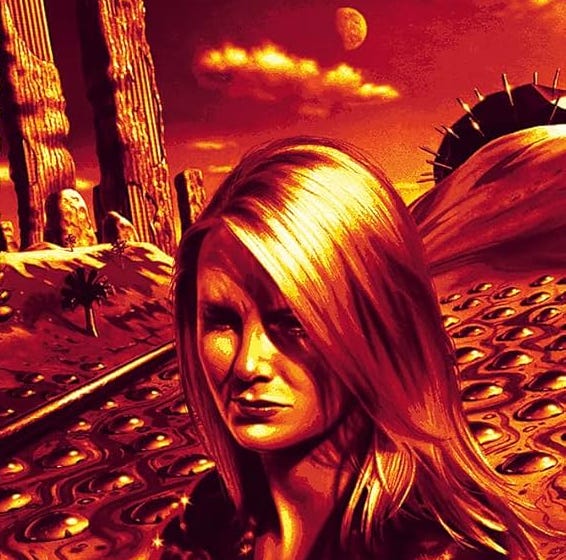
The hubris of tech giants and the likelihood of a future in which our scientific overreach has irreparably mutated natural life beyond recognition is what initially drew me to this book. The cover of my SF Masterworks copy features an eyeless woman standing on a pimply street covered in biological cells, a monstrous globular pincushion in the background, and a melted city skyline. This is the vibe I was after.
The story itself feels as if the author landed upon a good idea, one through which his (at the least) hobbyist interest in both computer science and cellular biology could be loosed to run amok together. And that they did. For the last fifth of the story I was sucked into the madness, the technical word salads, the exploration of intelligence and consciousness. Mostly just that last fifth, though.
While Greg Bear’s leanings, if I had to guess, fall closer to science than mysticism, there is still some interesting stuff in this book. The meat of the story is that a mediocre biologist working at a bio lab in California is secretly playing with biological cells as intelligent computers. It works, but not because our scientist (whose name I have already forgotten) is a genius, but because of dumb luck.
As it turns out, biological systems (for the sake of the story) already have something akin to universal intelligence baked in and our scientist simply unlocks their potential to meander outside of their strictly assigned functions. He un-binds the intelligence locked within their bio-processes, enabling their autonomous evolution as both something outside of what is human but simultaneously synonymous with human flesh, and through the cascade of ensuing consequences, ushers in an entirely new world. New consciousness. Eternal life. Pure gnosis.
Cool idea. I can see why he wanted to wrap a book around it.
I really enjoyed that these intelligent cells, once they had infected a host, would begin communicating with words they understood but would struggle with concepts that were more socialized and less apparent to them. They could reach into genetic memories, another inherent but yet undiscovered embedded natural system. Interestingly hierarchy seemed to be vital to their processes, control mechanisms deleting any agents which fail to adhere to their domains and instructions. There are echoes here of spirit interactions, and flirtations with deep animism, but the harshness of this operational efficiency seems even more akin to a technocratic bureaucracy. Identity and its true significance, or lack thereof, comes into play when the smart cells begin copying the consciousnesses of those in whom they gestate and grow, avoiding their true death by storing backups and copies of each person’s unique neurological constellation. These bits I really enjoyed, though they could have been more deeply explored.
On the list of things that didn’t work for me, there are several. Through much of the story the characters are constructed in a way that feels sort of like an afterthought. Details which could have been delivered chapters prior for greater effect and immersion are wedged into the same paragraphs that demands their presence in the first place. Rather than retroactively planted like seeds when editing, which play upon the passage of time when they come back around, giving them far greater significance by tricking the reader into feeling like they connected dots all on their own, these details instead feel obligatory. As if the author realized there wasn’t enough story there and simply got the job done. It doesn’t feel like the people in the story were much of a priority to the author, and that makes them feel less real. This, in turn, makes a story feel less bio-available. It’s harder to experience the story through the characters if the characters don’t feel like real people in some relatable way.
Often times dialog felt too scripted and a bit contrived, never flowing naturally enough to draw me in very deep. Because of this, the plot idea ended up feeling almost like a gimmick, for which everything else existed mostly to justify.
I get that this is a normal motivation to write a story. A cool idea needs a structure, characters, and events unfolding in order for it to bloom into a form where it can be shared with others, but I’m not sure these other parts should feel so utilitarian.
This would make an excellent limited series. Even better as a TV miniseries from the late 90’s where the aesthetic would have been shiny, slimed-up latex and plastics, food coloring and smoke machines. This story would have beamed with visuals to carry it. Those shallow-feeling characters would have only needed to appear engaging and the rubber and the slime and the food coloring would have done the heavy lifting. As it stands, the writing did not make up for these things for me, but I am still glad I read it.
This is the first book review I have written and it’s admittedly more for me than for you. I’m working on feeding my imagination the food it needs in order to rehabilitate it, and in this case the data it needs to trim the fat. I’m learning through osmosis again and writing about it helps process the harvested fruits.
If you enjoyed this and would enjoy more reflections like it, do drop a comment and let me know. Sometimes I think enough has been said about everything already, especially magic. There are more than enough opinions to go around on the matter and another opinion is not always what most people need. So as with the podcast I co-host, I will be reflecting on mundane things in a magical way, where relevant, in-between writings that are explicitly about magic.
I think what is best for the whole is not necessarily to shoehorn magic into every little thing, but rather to live life relatively normally with a firm knowledge that magic is real and feeling free to mention it when it arises, even in mixed company. Doing mundane things with magic in our hearts and liberally including our metaphysical reflections on them seems more beneficial to those in the periphery than directly preaching to them.
Let the normies scratch their heads. If you always talk like a baby to a child, they will never learn to speak like an adult. Let them catch up at their own pace, but avoid baby speak in their presence.
This one wasn’t exactly dripping in the esoteric, but the point is not to inject it as some contrivance like some half thought-out character’s relationship with their mom. The point is to allow the wider, spirit-inclusive, animist view of the world to roam freely and organically in all aspects of life, regardless of what company is kept.
The point is to gently but firmly tear down the partitions and allow a greater understanding to shine, free from shame or concern. It’s an integration. Materialism is dying and I want to be ahead of the curve. I want the reader to look back later on and connect the dots, feel clever, feel rewarded, and step willfully into the new Fortean dominant as seeds begin to sprout and branches begin to bloom.
So this is not really a book review, as it turns out. It’s the reification of a personal process of gracefully becoming fodder for future generations that is already in motion, one that I hope will be found in ever-increasing capacity reflecting back at me from out there in the digital, material, and etheric realms through the same osmosis by which I am re-learning to create. I pray those reflections, and my own, carry wisdom and compassion whenever possible on this insane, unpredictable adventure of both personal and human evolution towards new consciousness, eternal life, and pure gnosis.
Great write-up of a fairly interesting book mate. I felt the exact same as you back when I read it - carried along by the force of the speculative invention and the comfortable blanket of technobabble. (Shades of OG Star Trek, The Prisoner, NGE etc).
I must also sadly agree that the human element of the novel fell flat, however. The overall plot-shape wasn't deeply unpleasant or anything, but neither the characters nor their interactions ever grabbed me. Felt too declarative and (ironically) bloodless. The human drama component is sort of non-negotiable in a work like this: you want to first buy into the interpersonal dynamics and individual characterisations when a work is dipping its gnarled, too-many toed foot into the body horror pool. You have to care about the baseline humanity which is about to be reshaped and perverted. Blood Music sadly falls into that overcrowded company of science fiction novels which are more impactful as memories at some remove than as in-the-moment reading experiences.
"This would make an excellent limited series. Even better as a TV miniseries from the late 90’s where the aesthetic would have been shiny, slimed-up latex and plastics, food coloring and smoke machines. "
Beautifully observed. I've long wished this had been produced as a miniseries by either Chris Carter circa S4/5 of The X-Files or by the team behind the 1993 Stand miniseries.